
Summary
David Alfred Perdue Jr. was sworn in as the United States Ambassador to China in 2025, assuming the role at a critical juncture in U.S.-China relations marked by escalating trade tensions and geopolitical rivalry. A former U.S. Senator and business executive, Perdue’s appointment reflected a strategic decision by the Trump administration to place a politically experienced figure in Beijing ahead of high-stakes economic and trade negotiations scheduled in Switzerland. His tenure was viewed as pivotal in managing one of the world’s most consequential bilateral relationships, involving the two largest global economies and major military powers.
Perdue’s ambassadorship coincided with a period of intense tariff disputes initiated under President Trump, with both nations imposing steep duties on each other’s goods. The high-level talks in Switzerland sought to de-escalate these tensions by clarifying negotiable terms, though experts remained cautious about the prospects for a comprehensive deal. As ambassador, Perdue advocated for a firm U.S. stance on sensitive issues such as military expansion in the Pacific, human rights, and China’s ties with Russia, emphasizing the importance of publicly contesting policies contrary to American interests.
The appointment marked a return to the practice of naming former politicians to key diplomatic posts in China, contrasting with previous administrations’ preference for career diplomats, exemplified by Nicholas Burns’ 2021 appointment. This choice underscored the administration’s intent to leverage Perdue’s political and business experience, including his extensive work in Asia, to navigate the complexities of U.S.-China engagement. His swearing-in ceremony in the Oval Office, just days before the talks in Switzerland, highlighted the urgency and significance attributed to the ambassadorial role amid strained bilateral relations.
Historically, ambassadorial roles have played an essential part in maintaining channels of communication and preventing conflict escalation between the United States and China, dating back to ambassadorial-level talks in the 1950s and the normalization of diplomatic relations in 1979. Perdue’s appointment and the surrounding diplomatic efforts reflect the ongoing challenges and strategic importance of U.S.-China diplomacy in an era defined by economic competition and geopolitical tensions.
Background
The United States and the People’s Republic of China (PRC) have maintained a complex and evolving diplomatic relationship marked by periods of tension and negotiation. Formal diplomatic ties between the two countries were not established until the late 20th century, and prior to this, communication was primarily conducted through ambassadorial-level talks that began in 1955 in Geneva. These talks addressed issues such as the repatriation of nationals and served as a critical channel to prevent misunderstandings from escalating into conflict, playing a significant role in easing tensions in East Asia despite limited formal agreements.
Historically, U.S. diplomatic representation in China dates back to 1844, when Caleb Cushing negotiated the Treaty of Wanghia as commissioner. From 1858 to 1935, the U.S. envoy held the title Envoy Extraordinary and Minister Plenipotentiary to China, with the American legation in Nanjing being upgraded to an embassy in 1935. Since then, the chief diplomat has held the position of Ambassador Extraordinary and Plenipotentiary. Notably, figures such as Woodcock, who served as ambassador until 1981, later contributed to academia, reflecting the long-standing personal and professional connections underlying U.S.-China relations.
On the Chinese side, the development of their diplomatic service has been shaped by generations of ambassadors, many of whom had military backgrounds or were veterans of the Long March. This evolution influenced their diplomatic approaches and recruitment practices, with early diplomats often feeling out of place in foreign postings during the early years of the PRC.
In recent decades, it has become common for former politicians to be appointed as U.S. ambassadors to China. This trend is exemplified by the appointment of former Senator David Perdue, who was sworn in as ambassador ahead of crucial talks aimed at de-escalating tensions between Washington and Beijing. Perdue’s nomination signifies a return to the practice of appointing political figures, following President Joe Biden’s 2021 appointment of career diplomat Nicholas Burns. Perdue has acknowledged the significance of his role and expressed his intention to implement President Trump’s strategy in managing the bilateral relationship.
Ambassador’s Profile
David Alfred Perdue Jr., sworn in as the United States Ambassador to China in 2025, is a seasoned politician, diplomat, and businessman with extensive experience in both the public and private sectors. Prior to his ambassadorship, Perdue served as a U.S. Senator from Georgia from 2015 to 2021, representing the Republican Party. His nomination marks a return to the practice of appointing former politicians to key diplomatic posts in Beijing, following President Joe Biden’s appointment of career diplomat Nicholas Burns in 2021.
Before entering politics, Perdue built a notable career in business, holding executive roles at companies such as Sara Lee, Reebok, and Dollar General. During his tenure as Chairman and CEO of Dollar General, he oversaw significant growth, including the addition of approximately 2,200 stores and the creation of nearly 20,000 jobs, which he highlighted as a key credential during his political campaigns. His international business experience includes extensive work and residence in Asia and Europe, particularly in Singapore, Hong Kong, and China, providing him with a valuable perspective on the region.
Perdue holds a Bachelor of Science in Industrial Engineering (1972) and a Master of Science in Operations Research (1975), both from the Georgia Institute of Technology. His combination of public service and global business acumen has been noted as making him a well-qualified candidate to manage the complex U.S.-China relationship amid ongoing trade tensions.
As ambassador, Perdue has expressed a clear understanding of the role’s significance and has committed to advancing President Trump’s strategy toward China. Known for his critical stance on China, particularly regarding military expansion in the Pacific, Perdue advocates for a firm U.S. posture, emphasizing that it is the ambassador’s responsibility to contest China’s policies publicly on sensitive issues such as human rights and international security. His appointment comes at a pivotal time, coinciding with high-stakes economic and trade talks in Switzerland aimed at de-escalating the tariff war initiated under the Trump administration.
Swearing-In Ceremony
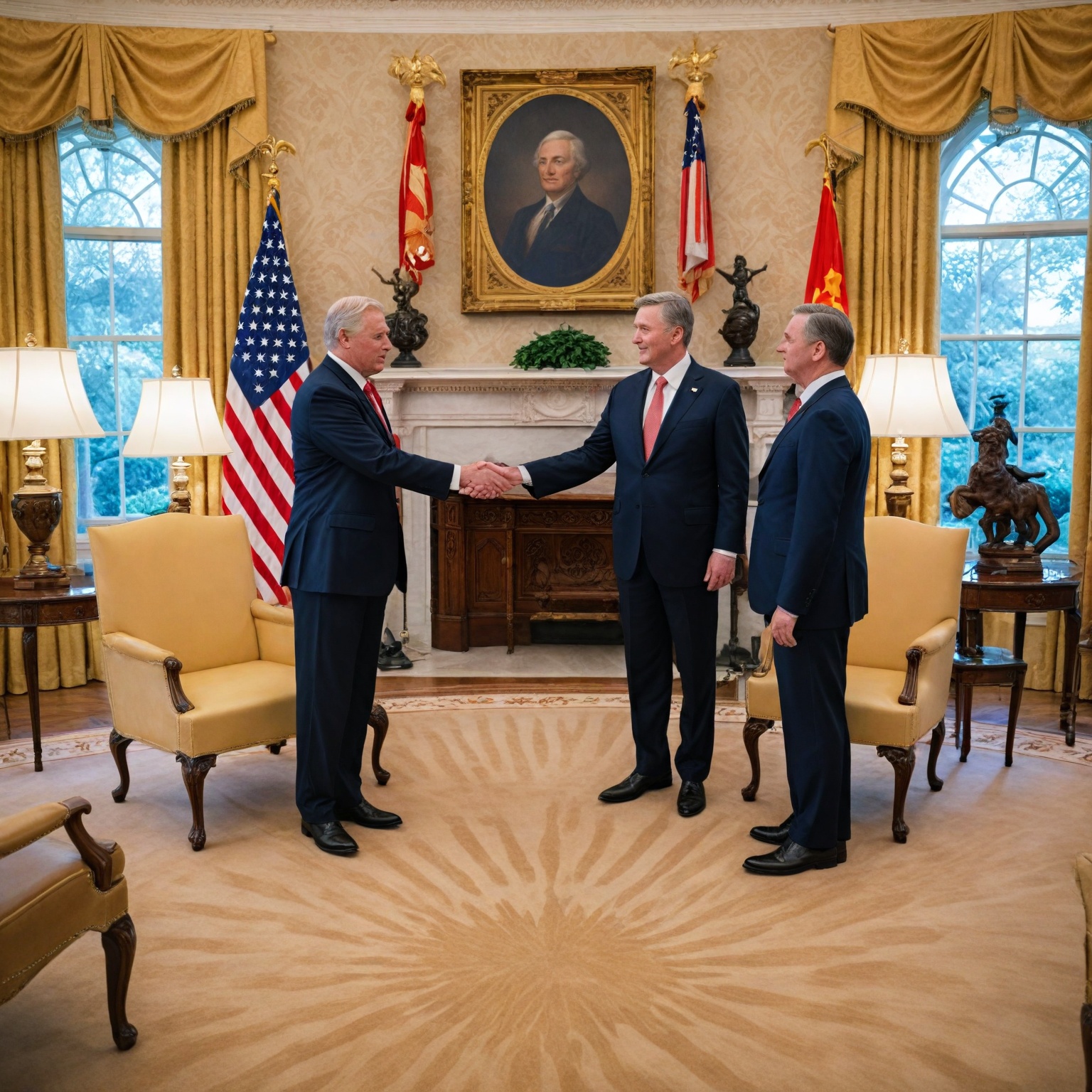
Former U.S. Senator David Perdue was officially sworn in as the United States ambassador to China in a ceremony held in the Oval Office during President Donald Trump’s administration. The timing of Perdue’s swearing-in was notable, occurring just days before a crucial round of high-level trade talks between the United States and China scheduled to take place in Switzerland. President Trump highlighted the significance of the moment, emphasizing that Perdue’s appointment was aligned with the diplomatic efforts to address ongoing tensions, particularly those related to the trade war between the two nations.
The White House issued a statement noting that, due to the swearing-in ceremony, the regular press briefing by the Press Secretary would be postponed to a later date. During the event, President Trump also urged Perdue to convey greetings to Chinese President Xi Jinping as part of his diplomatic mission. Perdue’s appointment was widely regarded as timely and critical for establishing effective communication channels amid strained U.S.-China relations. Experts like Yun Sun of the Stimson Center underscored the importance of having “credible points of contact” such as Perdue to help stabilize bilateral ties during this tariff conflict. Additionally, Senate Foreign Relations Committee Chairman Jim Risch characterized Perdue’s nomination as one of the most significant appointments to be considered by the Senate.
Perdue’s credentials as ambassador extend through March 2025, marking the formal start of his diplomatic tenure at a pivotal moment in U.S.-China relations.
Context of Appointment
The confirmation of the United States ambassador to China came at a critical juncture in U.S.-China relations, marked by heightened tensions amid an ongoing tariff war and geopolitical rivalry. Yun Sun, director of the China program at the Stimson Center, emphasized the importance of the appointment, noting that “credible points of contact” are essential for stabilizing the bilateral relationship during this period of economic and strategic competition. Senate Foreign Relations Committee Chairman Jim Risch also underscored the significance of the nomination, describing it as “one of the most important appointments” to be considered by the Senate.
The U.S.-China relationship is widely regarded by American officials as the most consequential bilateral relationship in the world due to the two nations’ status as the world’s largest economies and military powers. Officials have expressed concerns about China’s potential to displace the United States as the dominant global power, reinforcing the strategic weight of the ambassadorial role. This dynamic has been reflected in the appointments of other senior Trump administration officials, such as Marco Rubio, Michael Waltz, and Pete Hegseth, all of whom have taken hardline stances on China.
The ambassador’s role also involves addressing complex issues beyond trade and security, including human rights concerns and China’s relationship with Russia, which the ambassador has stated are matters for the U.S. government to contest publicly. This context illustrates the multifaceted challenges facing the ambassador in navigating a relationship fraught with economic disputes and ideological differences.
The appointment took place against the backdrop of trade negotiations scheduled to occur in Switzerland, where the main objective was to establish conditions for a potential deal by clarifying feasible agreements. The trade talks came amid economic uncertainty, with forecasts warning of a possible U.S. recession and reports of China’s factory activity contracting to its lowest level since December 2023. Observers viewed these meetings as a possible turning point, signaling a shift towards de-escalation rather than the achievement of a comprehensive trade deal.
Historically, U.S.-China diplomatic contacts have faced significant challenges, as exemplified by the ambassadorial-level talks that began in 1955 in Geneva prior to formal diplomatic relations. These talks, though limited in formal agreements, helped prevent misunderstandings from escalating into conflict and highlighted the enduring complexity of the bilateral relationship, particularly concerning Taiwan. More recently, negotiators such as Ambassador Hummel have played pivotal roles in shaping agreements on sensitive issues like arms sales to Taiwan, reflecting the long-standing and intricate nature of U.S.-China diplomacy.
In sum, the ambassador’s appointment occurred at a moment requiring delicate diplomacy to manage economic tensions, strategic rivalry, and broader geopolitical challenges, underscoring the critical importance of experienced and credible diplomatic representation.
High-Stakes Talks in Switzerland
In a critical development amidst escalating trade tensions between the United States and China, high-level trade talks were scheduled to take place in Switzerland, marking the first face-to-face discussions between the two nations in recent times. These talks, described as a significant step toward potentially resolving the ongoing trade war, were intended to establish the conditions for a deal by defining what was feasible to be agreed upon and what was not, according to Alfredo Montufar-Helu, head of the Conference Board’s China Center.
The meetings were set to begin on a Saturday, with U.S. Treasury Secretary Scott Bessent and U.S. Trade Representative Jamieson Greer meeting their Chinese counterparts, including Vice Premier He Lifeng, China’s top official on economic and trade matters with the U.S.. Notably absent from the talks was Peter Navarro, President Donald Trump’s most hawkish trade advisor on China and staunch advocate for tariffs.
The discussions came at a time when the Trump administration had significantly increased tariffs on Chinese imports, raising them to an average of 145%, while China retaliated with steep tariffs of its own. Despite these tensions, the very fact that both sides were willing to engage in face-to-face negotiations was seen as encouraging by observers.
However, the prospects for a breakthrough deal remained uncertain. President Trump reiterated that he would not consider rescinding tariffs on China as a precondition for talks, casting doubt on the likelihood of reaching an agreement during the weekend meetings. Experts warned that without clear objectives, the talks risked devolving into unproductive exchanges where each side would merely restate grievances.
Influence of the Ambassador on Negotiations
The appointment of the U.S. Ambassador to China, marked by Perdue’s recent swearing-in, played a significant role in shaping the environment for the high-stakes negotiations between the two countries in Switzerland. Perdue assumed his diplomatic post just days before the talks commenced, positioning him as a key figure amid escalating trade tensions. His presence was seen as vital to providing “credible points of contact” between Washington and Beijing, which analysts like Yun Sun from the Stimson Center emphasized as essential for stabilizing the bilateral relationship during a tariff war.
Although Perdue expressed enthusiasm about representing the Trump administration in China, stating he was “glad to be [Trump’s] man in China” during his Oval Office ceremony, his ability to influence the talks was expected to face significant challenges. Retired Senior Colonel Zhou Bo, a Chinese military expert, noted that the ongoing trade conflict created a difficult environment for any ambassador seeking to foster goodwill or meaningful dialogue. This tension was compounded by the absence of some of the Trump administration’s most hawkish trade officials, such as Peter Navarro, from the Geneva discussions, underscoring the complex internal dynamics influencing U.S. negotiation strategies.
Historically, ambassadorial roles have been pivotal in shaping U.S.-China interactions by facilitating communication and preventing misunderstandings from escalating into conflict, as exemplified by earlier ambassadorial talks that opened channels of negotiation even when formal agreements were limited. In this context, Perdue’s role was anticipated to extend beyond mere representation; he was expected to contest China’s policies publicly on critical issues like human rights, reflecting a broader diplomatic approach toward China under the current administration.
The ambassador’s influence also linked closely to the broader objectives of the talks, which aimed to establish feasible conditions for a trade deal and to clarify negotiable and non-negotiable issues. According to Alfredo Montufar-Helu of the Conference Board’s China Center, even without an immediate agreement, the face-to-face nature of these discussions was encouraging and vital for future progress. As such, Perdue’s diplomatic engagement was an integral part of creating a stable platform for ongoing dialogue amid the complex U.S.-China relationship.
Historical Context and Comparison
Diplomatic relations between the United States and the People’s Republic of China (PRC) have evolved significantly over the past several decades, marked by complex interactions and changing political dynamics. In the early years following the establishment of the PRC in 1949, Chinese diplomatic missions abroad largely mirrored those of other states, although their activities were deeply influenced by the revolutionary background of many ambassadors. These early diplomats, often veterans of the Long March and with military backgrounds, sometimes found themselves isolated and ineffective, metaphorically described as “baffled ambassadors” sitting on “cold benches” abroad. This period was characterized by limited engagement and difficulties in gaining acceptance within the international diplomatic community.
A notable phase in Sino-American relations before formal diplomatic recognition was the ambassadorial-level talks held in Geneva starting August 1, 1955. These talks were initiated by the Chinese amid high tensions and served as the primary channel of communication between the two countries for sixteen years. The negotiations focused on practical issues such as the repatriation of nationals and other mutual concerns. At this time, the United States was represented by Ambassador U. Alexis Johnson, and the PRC by Ambassador Wang Bingnan, highlighting the indirect nature of diplomatic contact prior to normalization.
The normalization of diplomatic relations in 1979 marked a turning point. Leonard Woodcock, who had served as the U.S. liaison to the PRC, was promoted to the role of ambassador upon the establishment of formal ties, symbolizing a new era of direct engagement. Since then, the role of U.S. ambassadors to China has continued to carry significant political weight, especially in periods of heightened tensions or strategic dialogue.
In comparison to earlier eras, modern appointments such as that of David Alfred Perdue Jr., a former U.S. Senator and business executive nominated for the ambassadorship, reflect a shift toward leveraging political and economic expertise in managing this critical bilateral relationship. This evolution underscores the continuity and change
Impact and Significance
The swearing-in of David Perdue as the United States ambassador to China came at a pivotal moment in Sino-American relations, underscoring the critical nature of the diplomatic engagement between the two countries. The U.S.-China relationship, characterized by the two largest global economies and most powerful militaries, is widely regarded by American officials as the most consequential bilateral relationship in the world today, with China seen as the sole competitor capable of displacing the United States as the dominant global power. Perdue’s appointment signaled a continued effort to implement President Trump’s strategic approach to China, emphasizing the importance of clear policy direction amidst complex geopolitical tensions.
Historically, the role of U.S. ambassadors in China has been influential in shaping diplomatic outcomes, from the normalization of relations that elevated Leonard Woodcock from liaison to ambassador, to ambassadorial-level talks in Geneva during the mid-20th century that helped ease regional tensions despite the absence of formal diplomatic ties. The ongoing ambassadorial presence serves as a critical channel for dialogue, reducing the risk of misunderstandings escalating into conflict in a highly sensitive regional context.
The high-stakes talks in Switzerland, at which Perdue’s ambassadorship was timed, aimed to establish the groundwork for feasible agreements amid difficult negotiations. However, experts have cautioned that the absence of clear objectives in these discussions risked devolving into unproductive exchanges, with both sides emphasizing their grievances rather than reaching consensus. Nevertheless, the talks and Perdue’s role in them hold significant potential to influence the trajectory of U.S.-China relations by maintaining a vital avenue for diplomatic engagement.
Furthermore, the personal connections many U.S. ambassadors have fostered with China have been an important, if less visible, element of bilateral relations. These relationships contribute to the broader context in which official diplomacy occurs, often shaping perceptions and opening informal channels of communication. In this light, Perdue’s tenure not only represents a continuation of formal policy implementation but also the ongoing effort to balance competition with dialogue in one of the world’s most consequential international relationships.
The content is provided by Blake Sterling, Direct Bulletins